



working principle of a Decanter Centrifuge
Material Input: Materials to be separated (such as suspensions or emulsions) are continuously fed axially through the feed pipe into the center of the drum (a horizontal cylindrical cavity) rotating at high speed.
Function of Centrifugal Field: The drum rotates at high speed (1500–4500 rpm), generating centrifugal force (separation factor Kc=gω2r, typically 1500–5000), whose intensity can reach thousands of times that of gravity. Under centrifugal force, denser particles (solid phase or heavy liquid phase) settle toward the inner wall of the drum, while less dense liquid phases (light liquid phases) gather toward the drum's center, forming radial stratification.
2. Solid Sedimentation and Screw Conveying
Sedimentation Process: Solid particles overcome the resistance of the liquid phase under centrifugal force, moving toward and depositing on the inner wall of the drum to form a sediment layer (such as sludge or crystal particles). The particle sedimentation rate is related to centrifugal force, particle size, density difference, and liquid viscosity (extended application of Stokes' law).
Differential Motion of the Screw:
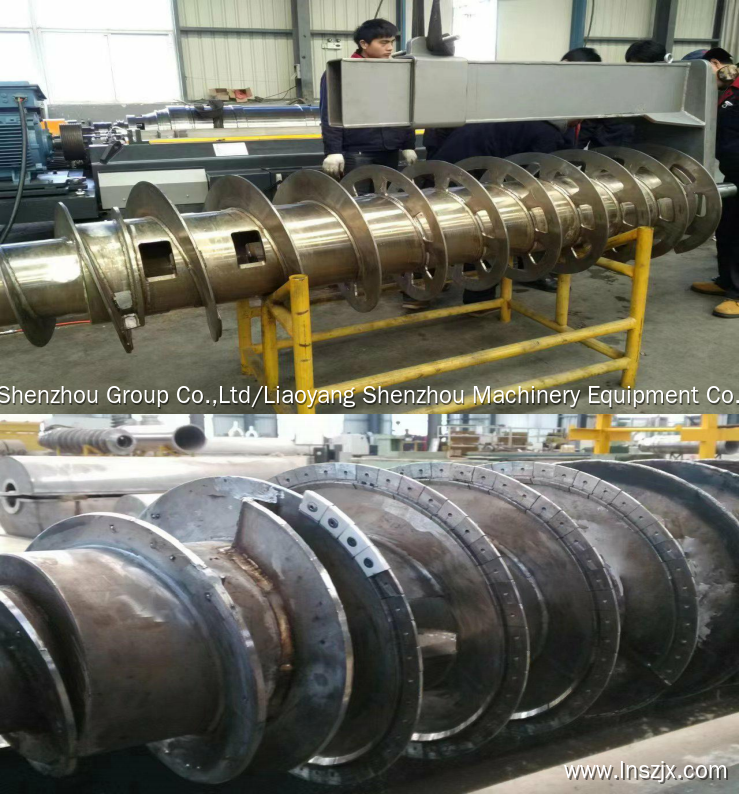
The screw conveyor rotates in the same direction as the drum but at a different speed (speed difference ), with the screw typically rotating slightly slower than the drum.
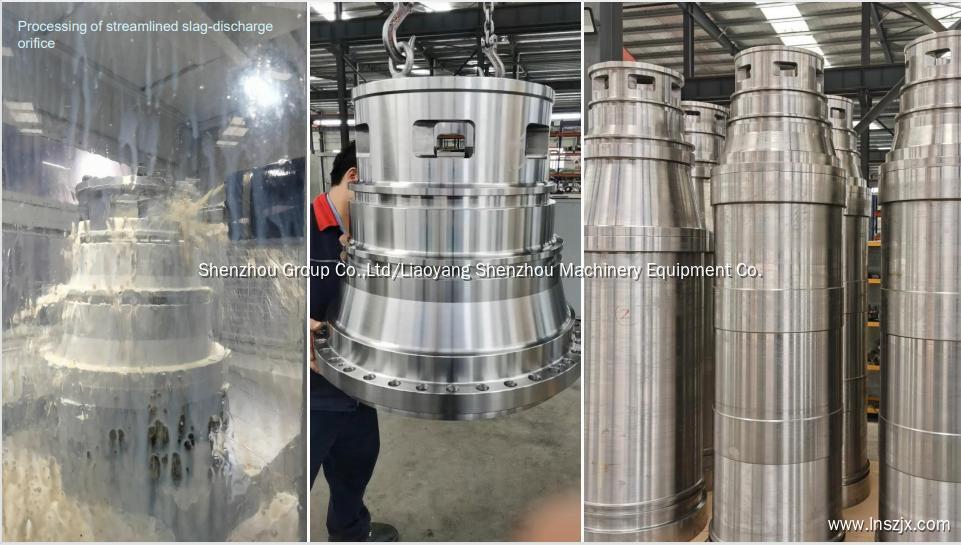
The speed difference creates relative motion between the screw and the sediment layer on the drum's inner wall. Screw blades push the sediment along the drum's axis toward the conical end slag discharge port (the pushing direction is consistent with the drum's axis).
Retention Time Control: A smaller speed difference means longer retention time of solids in the drum, leading to more thorough separation; a larger speed difference increases slag discharge speed, suitable for materials with high solid content.
3. Liquid Overflow and Discharge
Separation of Light Liquid Phase: The separated liquid phase (light liquid or clear liquid) forms an inner liquid ring, flowing axially along the drum toward the cylindrical end overflow weir and discharging continuously through the overflow weir (with adjustable height).
Control of Liquid Layer Thickness: The height of the overflow weir determines the thickness of the liquid ring (i.e., the volume of liquid in the drum). A smaller thickness means shorter retention time of the liquid in the drum, suitable for rapid separation; a larger thickness enables finer separation.
II. Analysis of Key Physical Mechanisms
1. Driving Force of Centrifugal Sedimentation
Separation Factor Kc: Directly reflecting the intensity of centrifugal force, a larger Kc results in faster particle sedimentation. For example:
When processing fine particles (e.g., 1–10 μm) or materials with small density differences (e.g., oil-water mixtures), increasing the rotational speed to enhance Kc is required.
Higher centrifugal force is needed to overcome fluid resistance for high-viscosity materials (such as polymer slurries).
2. Role of Screw Speed Difference
Source of Slag Discharge Power: The relative motion caused by the speed difference enables screw blades to exert axial thrust on the sediment layer, overcoming friction between the sediment and the drum's inner wall (related to material viscosity and solid compaction).
Torque and Energy Consumption: A larger speed difference increases screw pushing speed, but torque and energy consumption also rise; an excessively small speed difference may cause sediment accumulation and even drum blockage.
3. Hydrodynamic Characteristics
Laminar Flow: The liquid phase in the drum flows in a laminar state (low Reynolds number), reducing interference from turbulence on separation efficiency.
Axial Velocity Distribution: The axial flow velocity of the liquid phase in the drum must match the solid sedimentation rate to avoid un-sedimented particles being entrained and discharged by the liquid phase (i.e., the "short-circuit" phenomenon).
III. Principle Differences in Different Separation Scenarios
1. Solid-Liquid Separation (Single Liquid Phase Scenario)
Typical Process:
Solid phase (such as sludge particles) settles on the drum's inner wall to form a sediment layer;
The screw pushes the sediment to the conical end slag discharge port, and the dewatered solid phase (with reduced moisture content) is discharged;
Clear liquid (liquid phase) is discharged through the overflow port.
Key Control: Balancing throughput and separation efficiency by adjusting rotational speed (affecting sedimentation efficiency) and speed difference (affecting slag discharge speed). For example, sludge with high solid content requires reducing rotational speed and increasing speed difference to avoid drum blockage.
2. Liquid-Liquid Separation (Two Liquid Phases, e.g., Oil-Water Separation)
Stratification Mechanism: Due to density differences (ρheavy liquid>ρlight liquid), two immiscible liquids form inner and outer liquid rings under centrifugal force:
The heavy liquid phase (such as wastewater) is near the drum's inner wall, and the light liquid phase (such as oil) is near the center.
Dual Overflow Port Design: The heavy liquid phase is discharged through the outer overflow port, and the light liquid phase through the inner overflow port. Separation precision depends on the density difference between the two liquid phases and rotational speed (smaller density difference requires higher rotational speed).
3. Liquid-Solid-Liquid Three-Phase Separation (e.g., Biodiesel Production)
Three-Phase Stratification:
The heaviest phase (solid phase, such as catalyst residues) settles on the drum's inner wall and is discharged by the screw;
The intermediate phase (heavy liquid phase, such as glycerol) and the light phase (light liquid phase, such as methyl ester) form two liquid rings, discharged through different overflow ports.
Structural Optimization: Intermediate liquid phase collection devices or adjustments to overflow weir positions are required to ensure complete three-phase separation and prevent mixing.
IV. Key Operational Parameters Influencing the Principle
Rotational Speed (Separation Factor): Determines centrifugal force intensity, directly affecting particle sedimentation rate and liquid clarity.
Speed Difference: Controls solid phase retention time and slag discharge efficiency, requiring dynamic adjustment based on material viscosity and solid content.
Feed Rate: Excessively high feed speed results in insufficient liquid retention time, causing un-sedimented particles to be discharged with clear liquid and reducing separation efficiency.
Flocculant Assistance: For fine-particle materials (e.g., <1 μm), flocculants must be added to promote particle agglomeration, increase effective particle size, and enhance sedimentation speed.
V. Typical Cases of Principle Application
Wastewater Treatment: Sludge with 95% moisture content is centrifugally sedimented, and the screw pushes out mud cakes with 75%–85% moisture content. The clear liquid is reused or further treated.
Crude Oil Dehydration: Utilizing density differences among oil, water, and salt (water + salt > oil), high rotational speed (e.g., 3000 rpm) causes the water phase to settle on the drum's inner wall, while the oil phase overflows from the center, achieving desalting and dehydration.
Through the above principles, the decanter centrifuge achieves continuous and efficient multiphase separation. Its core advantage lies in integrating centrifugal sedimentation and mechanical conveying into a single device, balancing throughput and separation precision, with wide applications in industrial solid-liquid recovery and resource circulation scenarios.
