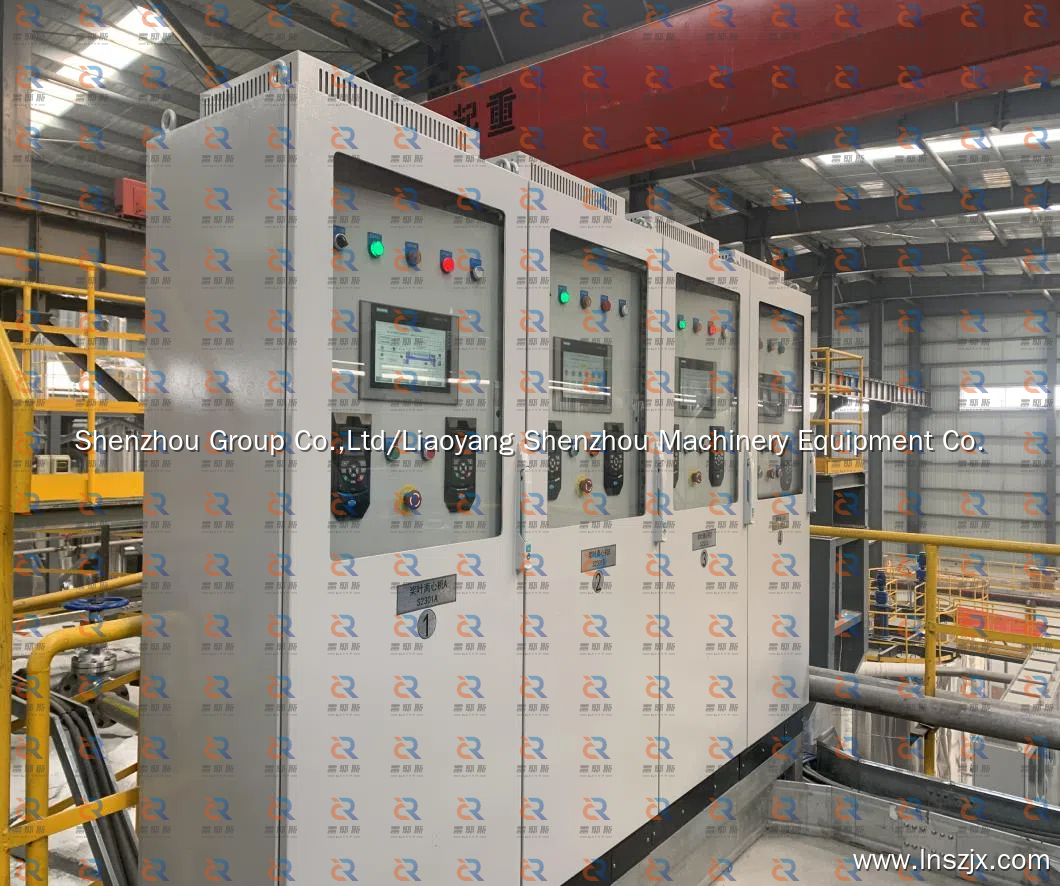
Factors affecting the separation efficiency of a decanter centrifuge
The separation efficiency of a horizontal scroll centrifuge (Centrífuga Espiral Horizontal) is influenced by multiple factors, which interact to jointly determine the equipment's operational efficiency and separation quality. Below are the main influencing factors and their analyses:
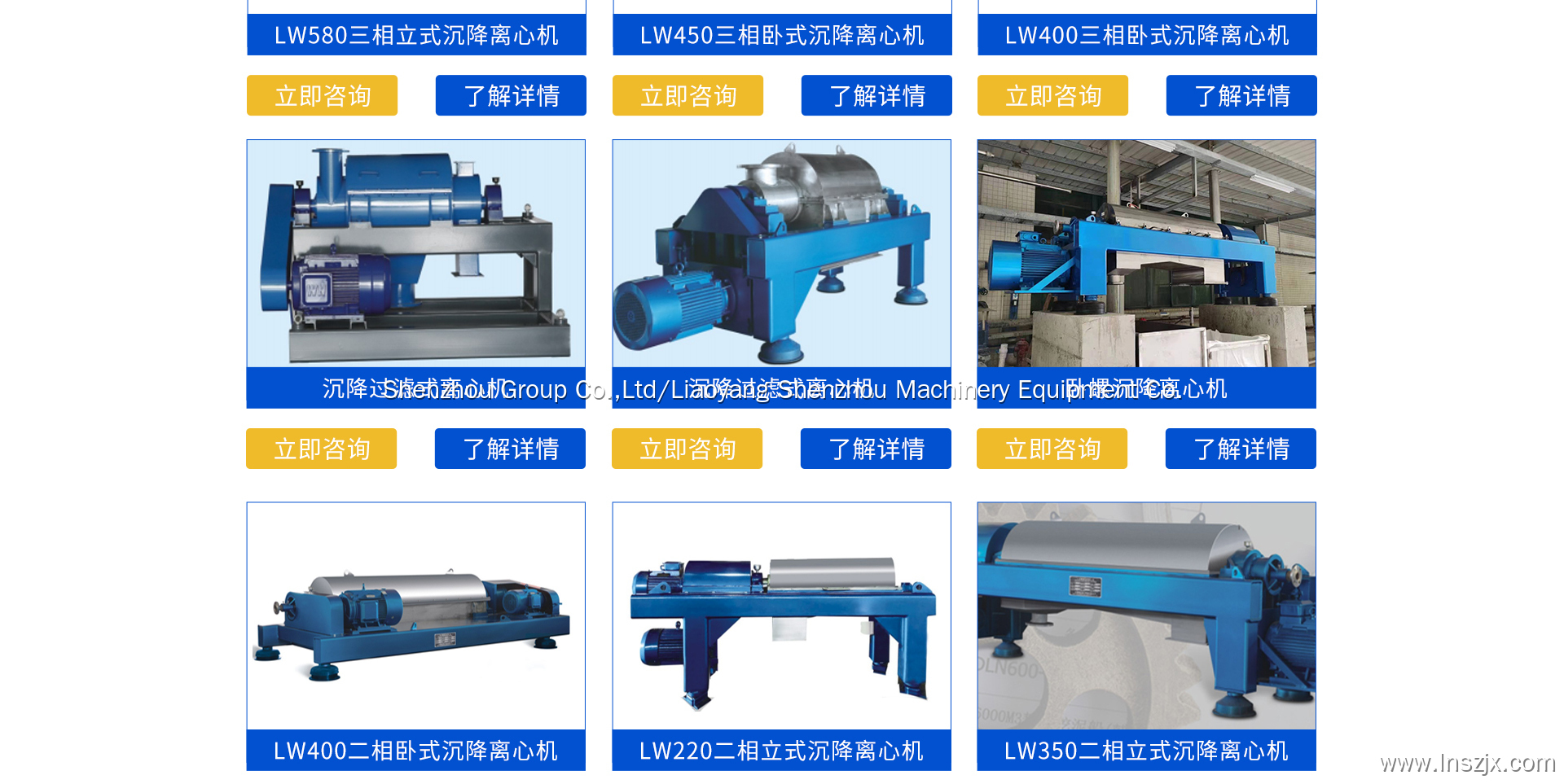
I. Equipment Parameters
1. Drum Speed and Centrifugal Force
- Core Principle: Speed directly determines the magnitude of centrifugal force (centrifugal force formula: \( F = m \cdot r \cdot \omega^2 \)). Higher speeds improve separation efficiency, especially for materials with small particle sizes or low density differences.
- Performance Impacts:
- *Low speed*: Suitable for easily separable materials (e.g., large-particle suspensions).
- *High speed*: Suitable for difficult-to-separate materials (e.g., emulsions, cell lysates), but requires attention to the equipment's mechanical strength and energy consumption limits.
2. Drum-Scroll Differential Speed
- **Definition of Differential Speed**: The difference between the drum speed and the scroll propeller speed (\( \Delta n = n_{\text{drum}} - n_{\text{scroll}} \)).
- **Performance Impacts**:
- *High differential speed*: The scroll pushes materials faster, increasing throughput, but reducing retention time in the drum and lowering separation precision (suitable for high-concentration suspensions).
- *Low differential speed*: Longer material retention time enables more thorough separation, but may cause sediment accumulation in the drum and reduce throughput (suitable for low-concentration, high-purity requirements).
3. Drum Aspect Ratio
- **Aspect Ratio = Drum Length/Diameter**:
- *Large aspect ratio*: Elongated drum shape provides a longer sedimentation path, enhancing separation efficiency (suitable for small particles or low-concentration materials).
- *Small aspect ratio*: Short and thick drum shape offers high throughput but lower separation precision (suitable for high-concentration, large-particle materials).
4. Weir Height and Liquid Pool Depth
- **Liquid Pool Depth**: Adjusted by the weir height; greater depth increases material retention time, improving separation but potentially reducing throughput.
- **Application Scenarios**:
- *High weir design*: Suitable for high-precision separation (e.g., biopharmaceuticals).
- *Low weir design*: Suitable for high-throughput, rapid separation (e.g., wastewater treatment).
II. Material Properties
1. Density Difference of Materials
- **Key Factor**: A larger density difference between the solid and liquid phases (\( \Delta \rho = \rho_{\text{solid}} - \rho_{\text{liquid}} \)) facilitates centrifugal separation.
- **Extreme Cases**: When the density difference is near zero (e.g., emulsions), higher speeds or flocculants are required to improve separation efficiency.
2. Solid Particle Size and Concentration
- **Particle Size**: Smaller particle sizes result in slower sedimentation rates, requiring higher centrifugal force or longer retention time (Stokes' law: \( v = \frac{2r^2(\Delta \rho)g}{9\mu} \)).
- **Concentration**:
- *Low concentration*: Dispersed solid particles are easy to separate, but throughput is low.
- *High concentration*: Particles agglomerate and settle easily, but may clog the scroll or drum, requiring increased differential speed to prevent overload.
3. Liquid Viscosity
- **Impact of Viscosity**: Higher viscosity increases resistance to particle sedimentation, reducing separation efficiency (e.g., preheating high-viscosity materials to lower viscosity).
III. Operational Conditions**
1. Feed Flow Rate and Distribution
- **Stable Flow Rate**: Fluctuations in feed flow can disrupt the flow field in the drum and affect separation efficiency. Flow stability must be maintained via metering pumps or variable frequency control.
- **Uniform Distribution**: The feed inlet's position and structure must ensure uniform axial entry of materials into the drum to avoid local overload.
2. Use of Flocculants
- **Function**: For fine-particle or colloidal materials, adding flocculants (e.g., PAM) promotes particle agglomeration, increasing particle size and density difference to enhance separation efficiency.
- **Considerations**: Flocculant type, concentration, and addition location must be optimized to avoid excessive viscosity increase due to overuse.
3. Equipment Wear and Maintenance
- **Scroll and Drum Wear**: Long-term processing of high-hardness materials can wear the inner walls, increasing clearances and reducing separation precision. Regular inspections and replacement of wear-resistant coatings (e.g., tungsten carbide) are required.
- **Bearings and Seals**: Poor lubrication or seal leakage can increase vibration, affecting speed stability and separation efficiency.
V. Process Parameter Matching:
1. Coordinated Adjustment of Speed and Differential Speed :
- **Principle**: High speeds require appropriate differential speeds to avoid sediment accumulation; low speeds can extend retention time by reducing differential speeds.
- **Example**: For activated sludge treatment, medium-to-high speeds (2000–3000 rpm) and low differential speeds (5–10 rpm) are typically used to achieve high solid recovery rates.
2. Coordination of Liquid Pool Depth and Differential Speed :
- *Deep pool + low differential speed*: Suitable for high-purity separation (e.g., food industry).
- *Shallow pool + high differential speed*: Suitable for high-throughput applications (e.g., chemical waste liquid treatment).
Conclusion: Optimization Directions:
1. **Equipment Selection**: Choose an appropriate aspect ratio and speed range based on material properties (particle size, viscosity, density difference).
2. **Parameter Tuning**: Optimize combinations of speed, differential speed, feed flow rate, weir height, etc., via orthogonal testing.
3. **Pretreatment**: Preprocess difficult-to-separate materials via flocculation, heating, etc., to improve separability.
4. **Maintenance Management**: Regularly inspect worn components to ensure stable equipment operation.
By comprehensively regulating these factors, the separation efficiency and economic benefits of horizontal scroll centrifuges can be maximized.