Professional Pusher Centrifuge for Chemical Industry
Working Principle of the Pusher Centrifuge
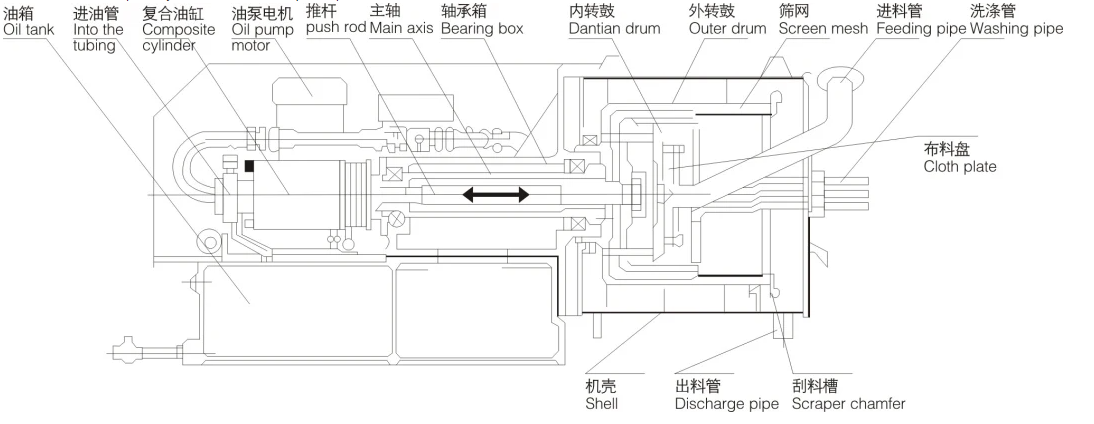
Driven at full speed by the main motor, the Pusher Centrifuge utilizes a two-stage inner and outer bowl system to achieve continuous solid-liquid separation through the following process:
-
Continuous Feeding & Liquid Separation: Slurry is continuously introduced through the feeding pipe and distributed evenly onto the filter screen of the inner bowl. Under centrifugal force, liquid passes through the screen and bowl pores to exit via the discharge pipe, while solids form a circular filter cake inside the inner bowl.
-
Reciprocating Piston & Secondary Separation: As both bowls rotate at the same speed, a piston pushes the inner bowl in continuous axial reciprocating movements. The pushing disc advances the filter cake outward from the inner bowl into the outer bowl for further separation and cake formation.
-
Solids Discharge: The outer surface of the inner bowl continuously pushes the filter cake along the outer bowl until it reaches the scraper groove and is fully discharged from the machine.
PRODUCT STRUCTURE PRINCIPLE
The main motor drives the inner and outer bowls to turn at full speed. The materials are continuously introduced from the feeding pipe and are evenly spread onto the inner filter screen wall of the inner bowl. Under the action of centrifugal force, after passing through the filter screen and bowl filtration pores, the liquids are discharged outside the machine from the liquid discharging pipe. The solids are retained in the inner bowl and form circular filter cakes. When the inner and outer bowls are turning at the same speed, the inner bowl is pushed by the piston to continuously make axial reciprocating movements. Thus, the pushing disc pushes the filter cakes at the inner bowl to continuously move outwards and enter the outer bowl for further separation and formation of circular filter cakes after they are discharged outside the inner bowl. The outer face of the inner bowl will push the filter cakes at the outer bowl to continuously move outwards until they are discharged outside the outer bowl, and then discharged outside the machine after passing through the scraping groove.