


Dewatering Tailings Gold Sludge Mining Thickener Decanter Centrifuge
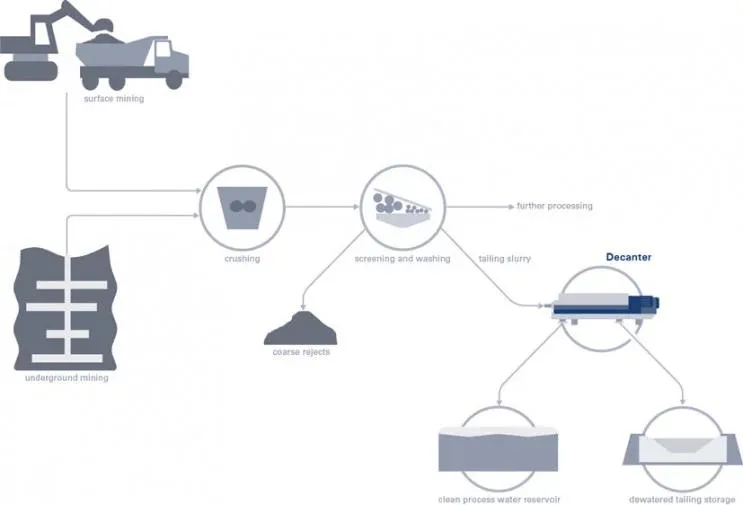
Tailings are still frequently stored in large settling basins or sludge ponds They are a great burden on the environment. The process water bound by the tailings remains unused. With modern dewatering solutions, mining residues can be treated economically and the process water that they contain can be recovered. This saves both space and cost and is environmentally friendly.
In mining, the term tailings refers to fine-grained residues in the form of sludges. They are created during the processing of ores and minerals. The resulting waste water or overburden sludge is partly contaminated with chemicals. Tailings are a risk to the environment when stored in sludge ponds. If the dam breaks, this can have a significant impact on humans and the environment.
The storage of tailings in sludge ponds is increasingly being replaced by the storage of dewatered tailings. Mining companies store the dewatered sludge on the ground. This complies with statutory regulations in most countries. In hard-to-reach and confined storage regions or in earthquake-prone areas, it is particularly advantageous if the tailings have been dewatered. This minimizes environmental risks and space requirements. The cleaned process water can be recycled. Mine operation costs are significantly reduced.
Recycling of captured process water
Shenzhou decanter centrifuges use considerably less fresh water than belt presses or chamber filter presses. Our decanter centrifuges efficiently separate solid particles down to a size of 10 µm without using flocculants. If the operator uses flocculants, it is possible to separate even finer solids from the liquid (water). The recovered process water is then clean enough to be returned to the process. As a result, mine operators can significantly reduce fresh water requirements.
Filter presses, such as belt presses and chamber filter presses, rely on the use of filter cloths or filter belts to process the overburden sludge. During prolonged use, deposits accumulate in the filter cloths and filter belts. This reduces the degree of dewatering.
Decanter centrifuges operate continuously - often around the clock. They do not require filter cloths and filter belts. A constant dewatering rate is therefore assured.
Recycling of the cleaned process water
Constant dewatering capacity
Operation around the clock is possible
Demand for fresh water is significantly reduced
Installation in confined areas
Mines or mining operations are often located in confined and difficult to reach locations. The space taken up by the dewatering system is an important factor. Given the same capacity and throughput, decanter centrifuges require considerably less space than other processing plants. Shenzhou decanter centrifuges can be installed almost anywhere - either as a fixed installation in a building or as a semi-mobile container unit. Our centrifuges only need a ground area of 5 x 10 meters.
A comparison
With a hydraulic capacity of 100 m³/h and a solids load of 25,000 kg, there are considerable differences in the weight of the plant:
Chamber filter press: 120 tons
Belt press: 65 tons
centrifuge: 16 tons
Dewatering tailings Gold Sludge Mining Thickener Decanter Centrifuge With Save water and cost
Increased safety in tailings storage
Dewatering tailings makes it possible to store dry processed sludge. Dry storage means a lower risk. The amount of wastewater in the settling ponds and the pressure on the dams is reduced. This significantly reduces environmental risks.
Shenzhou decanter centrifuges for dewatering tailings are manufactured only in China. Thus we can ensure the optimal quality of our machines. The quality of the materials used in mining and quarrying plays an important role. Materials which come into contact with the sludge are attacked by the sludge's abrasive components. A high-quality wear protection is therefore a must.
Special materials, coatings and supplementary measures ensure that the service life of Shenzhou decanter centrifuges spans many years. Shenzhou centrifuges allow for the easy replacement of wear parts such as inlet bushings. This saves time and reduces the cost of maintenance and servicing throughout the entire life of the machine.
Decanter centrifuges are increasingly finding their way into modern mining processes due to their low cost, low fresh water usage and low space requirements as well as their contribution to environmental protection.
Application:
pharmaceuticals and chemicals, etc.
1. Decanter centrifuge solid phase dehydration: dehydration effect for processing materials of solid particles.
2. Decanter centrifuge particle size classification: used in the removal of material of large diameter solid particles.
3. Decanter centrifuge liquid clarification: used for removing solid particles in the suspension liquid are clarified
Types Of Decanters
horizontal and conveyor centrifuges. The principle behind a decanter centrifuge is based on the theory of gravitational
separation. For example, if you fill a vessel with a mixture of mud and water, over time the weight of the mud will cause it to settle down at the base of the vessel. With the mud congealed at the bottom, the water will be forced upwards, creating a clear separation between the two.
Decanter Principles
A decanter centrifuge employs the same principles of gravitational force. However, unlike the glass mixture, the process is
expedited through the use of continuous rotation. In fact, rotation provides anywhere from 1000 to 4000 times the normal
gravitational force, reducing the time required for separation from hours to seconds.
Rotational Separation
The concept of rotational separation is similar to rides found at amusement parks and county fairgrounds. In these rides, placing yourself at an angle allows you to overcome the gravitational forces induced by rotation. Similarly, a decanter centrifuge is essentially a bowl tube that rotates at an extremely high speed. The bowl tube is equipped with an internal conveyor which moves in the same direction but at a different velocity.
How the Decanter Process Works:
* 1: The slurry is brought into the centrifuge through an intake pipe and onto a conveyor.
* 2: Utilizing an internal feed compartment, the conveyor moves the slurry through a nozzle into the bowl.
* 3: The bowl rotates at high speeds to induce centrifugal forces.
* 4: High speed rotation separates the solid material from the liquid in a matter of seconds.
* 5: The conveyor delivers the solid material upwards where it is discharged through a nozzle.
* 6: The solid material removed, the purified liquid is released from a separate output. The ability to purify a liquid makes
decanter centrifuges ideal for waste water treatment facilities. However, there are variety of industries for which such
centrifuges play an important role. Similar to other decanter equipment, centrifuges are simple to install and do not require a foundation to build upon. Their efficiency saves time and materials and is an essential component for many blue collar industries.
Technical parameter
Name | Unit | Parameter |
Model | LWM760 | LWM760*3040-N |
Capacity | M3/h | 10-160M3/H |
Solid content | % | 0.5~20 |
Design Rotation speed | r/min | 2260Variable frequency speed regulation |
Working rotation speed | r/min | 2000Variable frequency speed regulation |
Max Separation factor | G | 2060/Variable frequency speed regulation |
Drum diameter | Mm | 760 |
Drum length | mm | 3040 |
Slag outlet | Wear-resistant ceramic or hard alloy | |
Mud scraping position of spiral blade | Surface spray welding tungsten carbide protective coating | |
Drum | AISI304/316 stainless steel/2205/2507Duplex steel | |
Screw | AISI304/316 stainless steel/2205/2507Duplex steel | |
Hood | AISI304stainless steel | |
Feed pipe, Drainage and slag discharge pipe | AISI304stainless steel | |
Machine base | High Quality Carbon Steel | |
Screw Torque | Nm | 25000 |
Differential speed | Rpm | 45-80/Stepless adjustable |
Differential adjustment accuracy value | Rpm | ≤1 |
Noise | dB(A) | 90 |
vibration | mm/S | 7.1 |
Motor power | KW | 185(380/3/50HZ) |
explosion protection level | EEx e II T3 | |
Rated voltage | V | 600 |
Protection class | IP | 56 |
Insulation class | F | |
Frequency conversion electric control cabinet | 760 | SZ1 |