LW Series 2 Phase Calcium Carbonate Decanter Centrifuge
The LW series decanter centrifuge is a horizontal centrifuge designed for continuous feeding and continuous discharging. It uses centrifugal force to separate solid and liquid phases, with settling performance influenced by particle size, particle shape, the density difference between solids and liquids, and liquid viscosity.
This horizontal decanter centrifuge is widely used for solid dewatering, liquid clarification and separation, liquid-liquid-solid separation, and particle size classification of various suspensions. It is suitable for materials with particle sizes ranging from 0.005 to 15 mm, a solids concentration of 1% to 40%, and a working temperature of up to 100°C.
Product Description
This equipment is a LW series product, commonly used for dehydration and concentration. Widely used for maximum dewatering requirements of municipal and industrial wastewater sludge. It is characterized by small size, high rotational speed, and small processing capacity, and is used in situations where large separation factors and small processing capacity are required. According to practical use, it can be divided into: clarification type, dehydration type, concentration type, separation type, classification type, extraction type; Users can choose by themselves. Dehydration horizontal spiral centrifuge is suitable for easily separated materials with large particle size, large solid-liquid density difference, low viscosity, high concentration, strong processing capacity, and higher dryness than clarity. Materials such as sludge or wastewater containing fine particles usually require the addition of flocculants to condense the fine particles into large particles, which are then dewatered using a sedimentation centrifuge.
Working Principle
This equipment is a LW series product, commonly used for dehydration and concentration. Widely used for maximum dewatering requirements of municipal and industrial wastewater sludge. It is characterized by small size, high rotational speed, and small processing capacity, and is used in situations where large separation factors and small processing capacity are required. According to practical use, it can be divided into: clarification type, dehydration type, concentration type, separation type, classification type, extraction type; Users can choose by themselves. Dehydration horizontal spiral centrifuge is suitable for easily separated materials with large particle size, large solid-liquid density difference, low viscosity, high concentration, strong processing capacity, and higher dryness than clarity. Materials such as sludge or wastewater containing fine particles usually require the addition of flocculants to condense the fine particles into large particles, which are then dewatered using a sedimentation centrifuge.
Working Principle
The horizontal screw centrifuge relies on the density difference between the solid and liquid phases to accelerate the sedimentation rate of solid particles under the action of centrifugal force to achieve solid liquid separation. The centrifuge consists of two rotors, one called a drum, and the other rotor is a screw discharger (referred to as a screw). When the drum rotates at a high speed, the slurry inside the drum rotates with the drum and is subjected to a centrifugal force that is many times greater than gravity. In this way, solid particles will be separated from the liquid and settle onto the inner wall of the drum from the centrifuge drum shaft. The screw discharger located inside the drum rotates at a speed lower than the drum and pushes the deposited solid particles to the slag outlet, The differential rotational speed between the outer drum and the screw discharger depends on the transmission ratio of the differential and its rotational speed.
Advantage
1. Stable Horizontal Design with Low Vibration
The horizontal decanter centrifuge features a balanced layout between the electric motor and rotating bowl, helping improve overall operating stability and minimize vibration during continuous operation. The JG-type rubber shock absorber requires no anchor bolts, simplifying equipment installation.
2. Dual-Motor Control for Flexible Speed Adjustment
The dual electric motor system independently controls the bowl and scroll, enabling stepless speed adjustment for flexible control of centrifuge operating conditions. This design helps optimize separation performance according to different processing requirements.
3. Wear- and Corrosion-Resistant Components
The scroll conveyor flight is protected with abrasion-resistant alloy coating or hard alloy welding to improve wear resistance. Key components of the horizontal decanter centrifuge, including the rotating bowl and scroll, are manufactured from corrosion-resistant stainless steel or duplex stainless steel, supporting reliable operation under demanding processing conditions.
4. Multiple Differential Drive Options
The industrial centrifuge offers three differential drive options:
✔ Cycloidal gear drive
✔ Planetary gear drive
✔ Hydraulic differential drive
These options provide a wide range of differential speed adjustment, allowing the decanter centrifuge to handle different types and concentrations of solids.
5. Comprehensive Safety Protection
Multiple protection systems are integrated into the mud dewatering equipment to support safe and reliable operation, including:
✔Over-vibration protection
✔ Bearing temperature monitoring
✔ Scroll torque protection
✔ Bowl and differential speed monitoring
✔ Nitrogen-filled explosion-proof protection
✔ Motor overload protection
✔ Motor overheat protection
These systems help monitor critical operating conditions and reduce risks during continuous centrifuge operation.
Main Characteristics
Key Features of Shenzhou Machinery Sludge Dewatering Decanter Centrifuge
1. Tungsten Carbide Wear Protection
A high solids content can accelerate wear on centrifuge components that come into direct contact with sludge. To address this issue, Shenzhou Machinery uses tungsten carbide material on key wear parts, including the screw blade, solids discharge port and sludge distribution port. This wear protection helps reduce wear on critical components and extend the service life of the decanter centrifuge.
2. Dual-Motor Drive for Lower Power Consumption
Power consumption is an important concern for users. To provide sufficient torque for pushing out the solid cake, Shenzhou Machinery equips the decanter centrifuge with two drive motors using a common DC bus configuration. Under normal operating conditions, the rear motor works as a generator, helping reduce power consumption during the operation of the dewatering decanter centrifuge.
3. VFD & HMI Control System
Shenzhou Machinery equips the sludge dewatering decanter centrifuge with a VFD control panel. According to different sludge conditions and treatment targets, users can set the operating speed and differential speed of the machine. All settings can be adjusted through the HMI touchscreen, providing convenient control of the centrifuge operating parameters.
4. Temperature & Vibration Monitoring
Temperature and vibration sensors are integrated into the control system to monitor the operating condition of the decanter centrifuge. The signal receiving device installed in the control panel allows the VFD control panel to display operating conditions and monitor the machine during operation. For the feeding system, Shenzhou Machinery can also install VFDs and other electrical components in the control panel for feeding pump control.
5. Integrated Sludge Dewatering Package
In the Shenzhou Machinery sludge dewatering package, the decanter centrifuge serves as the core equipment and can be combined with a sludge feeding pump, polymer dosing unit and solid cake screw conveyor to form an integrated sludge dewatering package. This configuration integrates sludge feeding, polymer dosing, centrifugal dewatering and solid cake conveying into one complete system for sludge treatment applications.
Main Choices
According to user's requirement, the product contact parts can be made of austenite stainless (321, 316L….), Haynes alloy, titanic alloy or other anti-erosion materials.
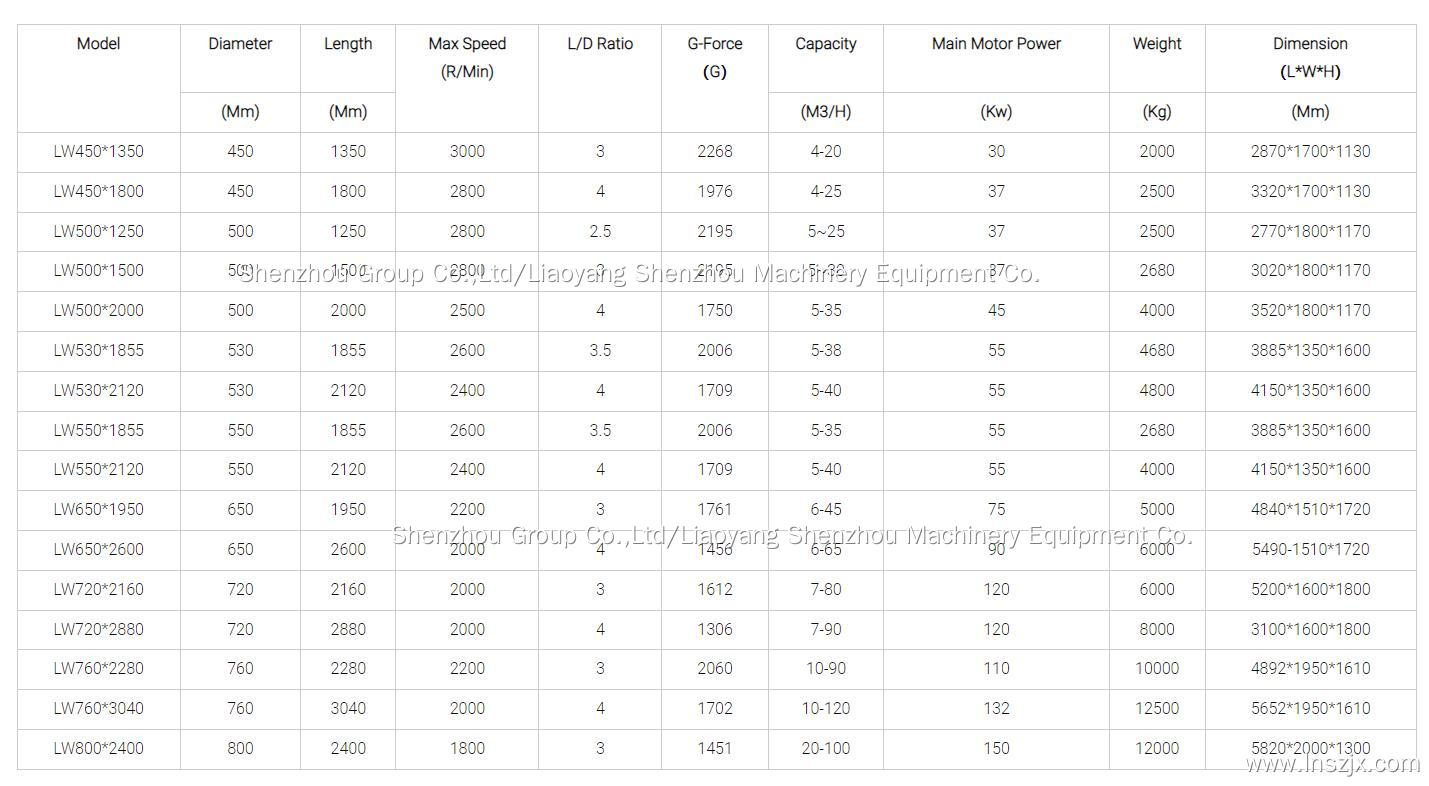
Technical Parameter
Product Details
Spiral Feeder
The spiral feeder is made of 304 stainless steel, and the forging process is adopted , which can enhance its corrosion resistance.
BD structure, spraying hard alloy powder on the surface of the blade. The thickness is over 3mm .The spiral outlet is equipped
with a replacement hard alloy sleeve, which greatly prolongs the service life of the machine blade. Because of this technology,the maintenance cost of the machine is greatly reduced. Other parts in contact with the material are 304 stainless steel.
Drum
The drum is cast by 304 stainless steel in centrifugal casting, the forging process is adopted , which can enhance its corrosion resistance, The replaceable alloy sleeve is installed in the solid state outlet, so that the mother material of the drum's outlet is not worn, and the wear-resistant bar is installed in the drum to make the drum inside not worn.
PLC Control Panel
The electrical control adopts the double conversion auto control system, which can display the parameters such as frequency, rotation speed, differential speed and current of operating major and auxiliary electrical engine.
Eletrical Components: SIEMENS/Schneider/ABB
Products Description
The equipment has the characteristics of continuous feeding and discharging. The chemical separation equipment has been applied to two-phase (solid liquid) and three-phase (solid liquid liquid) slurry separation in chemical, pharmaceutical, environmental protection, mining, food and other industries. The various materials listed below are only partially used, and various new uses are increasing. For specific materials, it is necessary to pass tests or analogies to determine the type and technical parameters of the corresponding centrifuge. Chemical, petroleum, food, pharmaceutical, kitchen oil and water residue, magnetic particle treatment, sewage treatment plants, pharmaceutical plants, food plants, laboratories, petroleum industry, new energy industry, biotechnology, chemical fiber, polymeric materials, leather manufacturing, cosmetics, printing and dyeing plants, knitting plants, environmental protection technology, and so on.
Chemical industry: polyethylene, polystyrene, fumaric acid, urea, ammonium sulfate, potassium nitrate, polyamide, caprolactam, sodium carbonate, compound fertilizers, sodium chloride, traditional Chinese medicine, sodium sulfite, bile alum, PVC, ferrite, polypropylene glycol, activated carbon, various resins, etc.
Food: Citric acid, tartaric acid, sodium glutamate, amino acids, salt, granulated sugar, xylitol, corn fiber, saccharin, flax, coffee, etc.
Mining industry: iron sulfate, copper sulfate, nickel sulfate, amine thiocyanate, etc.
Industrial and municipal wastewater treatment
Oil and gas drilling mud/drilling fluid control
Washing, Separation, and Dehydration of Starch
Isolation of Antibiotics from Mycelia and Fermentation Broth
Dehydration of Soybean and Wheat Protein
Dehydration of fish meal and meat
Dehydration of distiller's grains.
Clarification and Extraction of Fruit Juice
Isolation and purification of animal and vegetable oils
Production and purification of olive oil, palm oil, and avocado oil
Separation and purification of coal tar
Classification of kaolin and graphite
Grading and dehydration of dyes and pigments
Clean coal foam flotation and slime dewatering
Working principle of mineral classification and dehydration
Characteristics Of Suspension Materials
he larger the solid particles in the material, the easier it is to separate. The size of the solid particles varies, and the final separation effect is determined by the small particle solid phase. This machine can generally remove solid particles above 5 um. When the solid particles are especially small, they will not settle and separate out, but will be discharged together with the clarified liquid; The final separation effect depends on the distribution of solid particles in the material. The more particles above 5 um, the better the separation effect; On the contrary, the separation effect is worse.
Generally, crystalline solids and fibrous solids are easier to separate, while flocs and paste solids are more difficult to separate. Due to the large maximum water solubility of flocs and paste solids, when spirally pushing sediment, it is easy to slip and affect the separation effect, so the flow rate should not be too large when separating flocs and paste solids.
The greater the weight difference between the solid phase and the liquid phase, the better the separation, and vice versa, the worse the separation effect The lower the liquid viscosity, the easier it is to separate. When the liquid viscosity is higher, the solids entrained in the clarified liquid increase, and the separation effect becomes worse. At this time, the material temperature can be increased and the viscosity can be reduced to improve the separation effect (the maximum feed temperature is not greater than 95 ℃).
Selection Of Feed Flow (I.E., Processing Capacity)
From a separation perspective, the smaller the feed flow rate, the smaller the axial flow rate of the material in the drum, the longer the residence time of the material in the drum, and the better the separation effect. As the feed volume increases, the axial flow rate increases, and the retention time of the material in the drum decreases. The separation effect becomes worse.
The feed volume of the centrifuge is also limited by the maximum slag removal capacity of the spiral. If the feed volume is too large, the separated sediment will not be discharged in a timely manner, resulting in blockage of the drum.
Therefore, when using the centrifuge, the appropriate feed flow rate should be selected based on the material characteristics, separation requirements, and the solid content of the material, Generally, when the solid content is large, the feed rate should not be too large. The appropriate feed rate can be determined after comparing the separation effects of various flows. Generally, it is recommended that the flow rate should not be too large for materials that are difficult to separate, and the flow rate for materials that are easy to separate can be larger. However, attention should be paid to the maximum slag discharge amount of the spiral, otherwise it will cause material blockage
Products Packaging
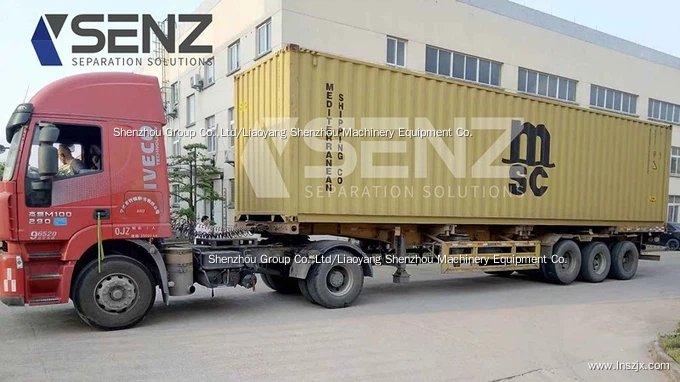
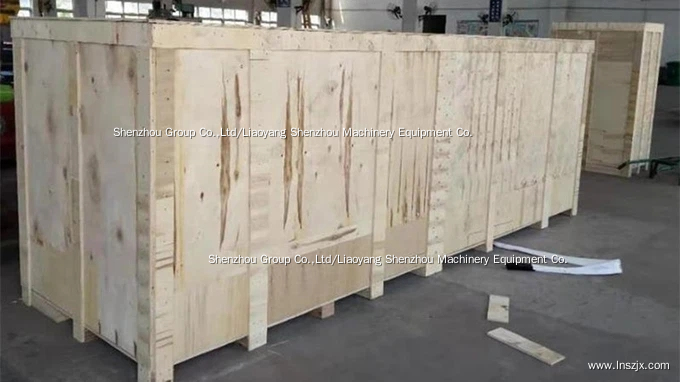
To better ensure the safety of your goods, professional, environmentally friendly, convenient and efficient shipping packaging services will be provided.
Technical Service
- Technical direction when installation, debugging
- Training for operation and maintain worker
FAQ
Q1.What's your advantage? Why we choose you?
A:1) More than 50 years experience of centrifuge & separator production and R&D.We have the most professional techniques and team. More advantage in price
2)Great production capacity Sustainable Supply . According to customer requirements, We support the customized include package.
3)We use famouse good quality materials and the best production process
Q2.What's the Payment?
A:T/T would be better with quick transfer and few bank fees. LC could also be accept, but the
procedure is complex and the fee is high. You can also use Western Union and Paypal.
Q3.Are you a factory or trading company?
A:We are a professional manufacturer. We are warmly welcome clients from worldwide to visit our factory and cooperate with us.
Q4.How long is the warranty period ?
A:12 months.
Hot Tags: industrial large capacity centrifuge, China industrial large capacity centrifuge manufacturers, suppliers, factory, Soy Protein Decanter Centrifuge, Centrifuge installation, Experimental centrifuge speed, digester wastewater treatment, sedimentation centrifuge, Starch dehydration equipment
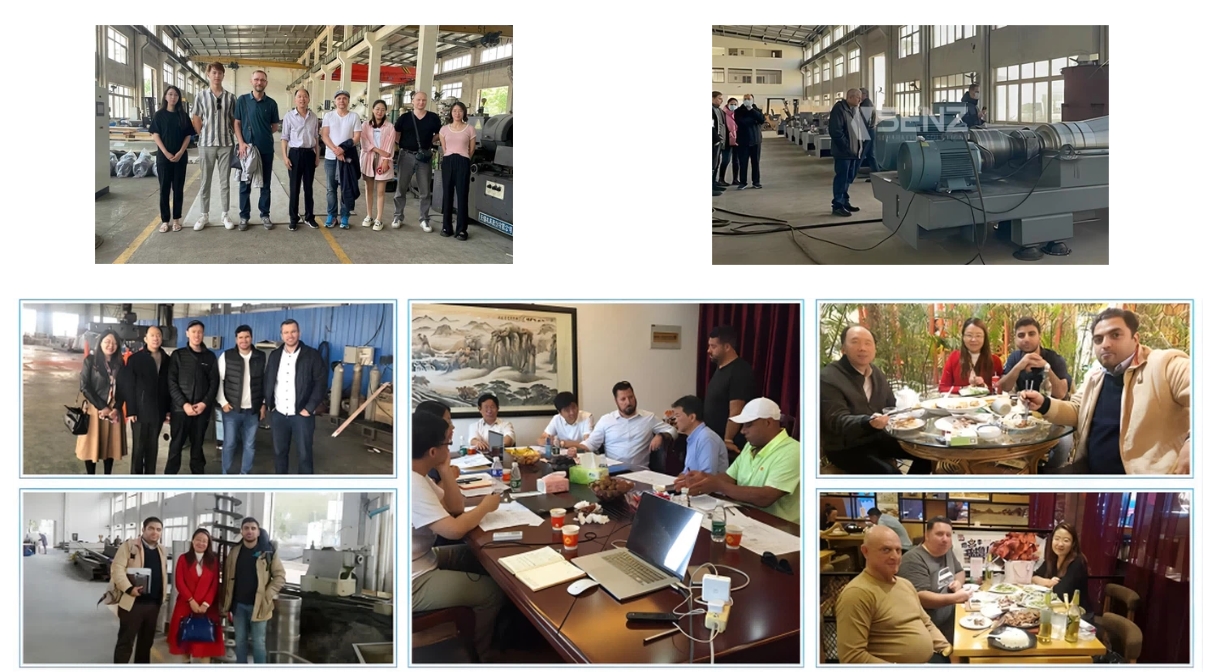
Customers visited Shenzhou Group From other countries: