


Table of Contents
Application of Decanter Centrifuges in the Mining Industry
2025-11-15
×
# Decanter Centrifuges: Core Solid-Liquid Separation Equipment in the Mining Industry
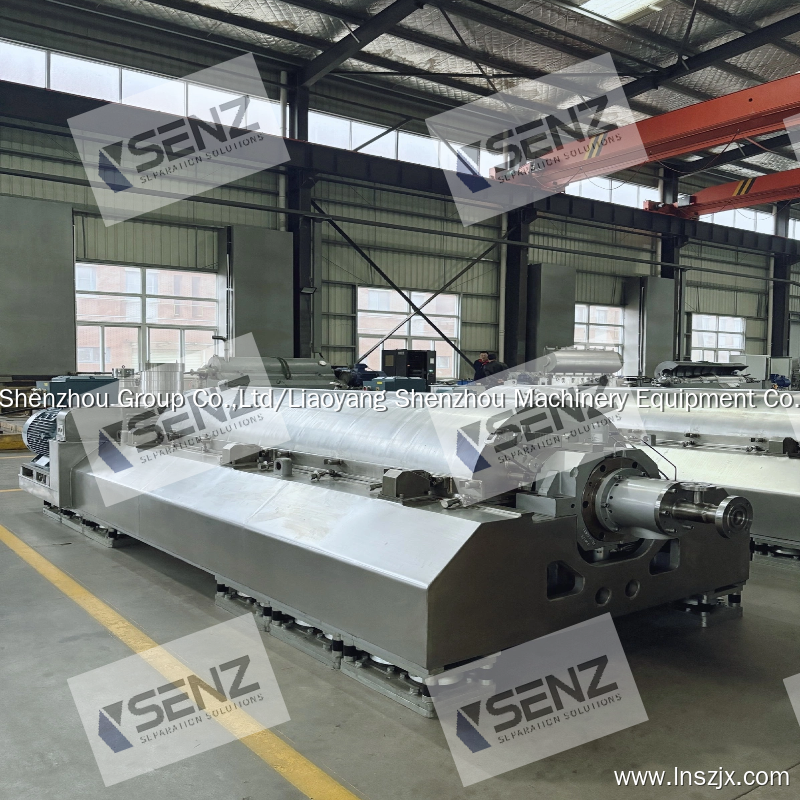
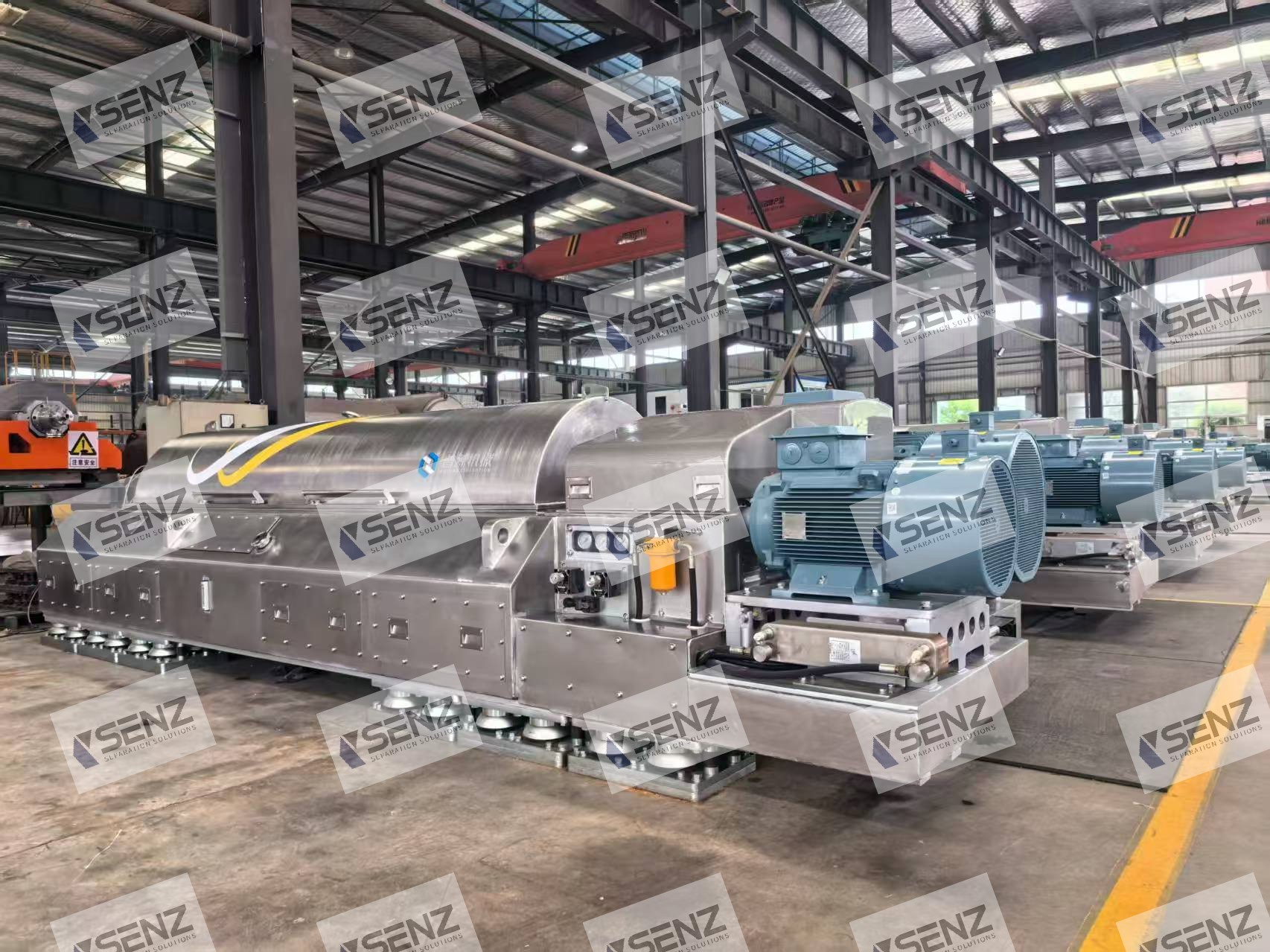
Decanter centrifuges are the **core solid-liquid separation equipment** in the mining industry. They are mainly used in critical processes such as mineral slurry dewatering, tailings treatment, and wastewater reuse. These centrifuges efficiently separate minerals from water/reagents, balancing production efficiency with environmental compliance, and are suitable for various mining scenarios.
## Core Application Scenarios
### 1. Mineral Slurry Dewatering and Separation
It processes mineral slurries after flotation and gravity separation to separate solid minerals from reagent-containing aqueous solutions. For example:
- In the coal industry, it dewaters clean coal/tailings coal.
- In metal mines (copper, iron, lead-zinc mines), it dewaters concentrates.
The result is solid minerals with low moisture content (facilitating transportation and subsequent processing), while the aqueous solution is recycled for reuse.
### 2. Tailings Dry Stacking Treatment
For mining tailings (waste slag slurry after mineral processing), solid-liquid separation is achieved through centrifugal force:
- The moisture content of tailings slag can be reduced to **20%-30%**, forming dry-stacked tailings. This reduces the land occupation of tailings ponds and lowers the risk of dam failure.
- The separated clean water can be reused in mineral processing processes, saving water resources.
### 3. Mining Wastewater Purification
It treats mining wastewater and mineral processing wastewater (containing suspended solids, heavy metal ions, and mineral processing reagents):
- Removes solid particles and some pollutants from water.
- Enables wastewater to meet either the standards for recycling (e.g., make-up water for mineral processing) or discharge, preventing pollution to soil and water sources.
### 4. Heavy Medium Recovery
In the coal heavy-medium separation process, it recovers heavy media (e.g., magnetite powder) from mineral slurries:
- Reduces heavy medium loss and lowers mineral processing costs.
- Simultaneously purifies coal preparation wastewater.
### 5. Mineral Classification and Purification
For fine-grained minerals (particle size: **2-50μm**), it achieves coarse-fine particle classification by adjusting centrifugal parameters:
- Enriches target minerals and improves the efficiency of subsequent mineral processing.
- Typical applications include the classification and purification of quartz sand and kaolin in non-metallic mines.
## Core Advantages in Applications
### 1. Efficient Continuous Operation
- Processing capacity ranges from **10-100 m³/h**, suitable for large-scale mining production.
- No shutdown is required for slag discharge, significantly improving mineral slurry processing efficiency.
### 2. Wear and Corrosion Resistance
- Wetted parts are made of wear-resistant alloys (e.g., duplex steel, Hastelloy) or rubber linings.
- Resistant to erosion from high-hardness mining slurries (containing wear-resistant particles like quartz sand) and acidic/alkaline mineral processing reagents, ensuring a long service life.
### 3. Water Conservation and Environmental Friendliness
- Water resource recovery rate after separation exceeds **80%**, reducing fresh water consumption in mines.
- Dry stacking of tailings reduces environmental pressure, aligning with the requirements for "green mine" construction.
### 4. Strong Adaptability
- Capable of handling slurries with high solid content (**5%-40%**) and high viscosity (**≤200 mPa·s**).
- By adjusting rotational speed (**2000-4500 rpm**) and differential speed (**3-20 rpm**), it adapts to the processing needs of different mineral types, including coal, metal ores, and non-metallic ores.
## Typical Application Cases by Mineral Type
### 1. Coal Industry
A large coal preparation plant of a coal mine adopted **LW series decanter centrifuges** to process tailings slurry after heavy-medium coal separation:
- Processing capacity: 30 m³/h.
- Moisture content of tailings coal reduced from 75% to 25%.
- Magnetite powder recovery rate reached 98%.
- Annual savings in heavy medium procurement costs exceeded 2 million RMB.
- All wastewater was reused in coal preparation, saving 120,000 tons of water annually.
### 2. Copper Mines
A copper mine in Jiangxi Province used decanter centrifuges for dry stacking of flotation tailings:
- Solid content of tailings slurry: 25%.
- Moisture content of tailings after treatment: 28%.
- Land occupation for dry stacking was only 1/3 of that of traditional tailings ponds.
- COD removal rate of separated wastewater reached 60%, meeting the standards for recycled mineral processing and reducing pollution to surrounding rivers.
### 3. Quartz Sand Mines
A quartz sand processing plant in Anhui Province used decanter centrifuges for fine-grain classification:
- Separated impurity particles with particle size ≤10 μm.
- Purity of quartz sand increased from 98.5% to 99.9%.
- Classification efficiency was 40% higher than that of traditional spiral classifiers.
- Suitable for the production needs of high-end glass and electronic-grade quartz sand.
### 4. Iron Ore Industry
An iron mine in Hebei Province used decanter centrifuges to process iron concentrate slurry after magnetic separation:
- Moisture content of concentrate reduced from 35% to 18%, facilitating subsequent sintering and pelletizing.
- Simultaneously recovered flotation reagent solutions from the slurry; reagent consumption decreased by 30% after recycling.
## Key Technical Adaptation Points
### 1. Material Selection
- For high-hardness slurries (e.g., coal, quartz sand): Wetted parts use **wear-resistant alloy + rubber linings**.
- For slurries containing acidic reagents (e.g., copper ores, pyrite): **316L stainless steel or Hastelloy** is selected.
### 2. Parameter Adjustment
- Rotational speed adjustment: Choose **2000-3000 rpm** for coarse-grained slurries and **3000-4500 rpm** for fine-grained slurries.
- Differential speed is controlled at **3-20 rpm** to balance separation efficiency and solid recovery rate.
### 3. Process Matching
- Often used in combination with thickeners (for pre-concentration) and filter presses (for deep dewatering), forming a process chain of "**pre-concentration - centrifugal separation - deep dewatering**".
- Example: Tailings are first concentrated to 30% solid content by a thickener, then separated by a decanter centrifuge, and finally dewatered to a moisture content of ≤15% by a filter press.
 |  |
ReviewsNumber of comments: {{ page.total }}
I want to comment?
{{item.nickname ? (item.nickname.slice(0, 2) + '*****') : item.source === 1 ? 'mall buyer' : '--'}}
{{item.comment_time}}
Review in the {{item.country}}
Reviews
Merchant
{{replyItem.nickname ? (replyItem.nickname.slice(0, 2) + '*****') : replyItem.source === 1 ? 'mall buyer' : '--'}}
{{replyItem.parent_nickname ? (replyItem.parent_nickname.slice(0, 2) + '*****') : '--'}}
{{replyItem.is_merchant_reply === 1 ? replyItem.reply_time : replyItem.comment_time}}
Review in the {{replyItem.country}}
Reviews

No customer reviews
Recommended for you
Leave A Message
Welcome all who care engaged in the separation and filtration to work with us,and we are also looking for the qualified world wide agents to provide better service and deep marketing.
Copyright © 2026 Shenzhou Machinery is a core subsidiary of Shenzhou Group | Sitemap